Modelo 349 for freelancers with EU clients: the recapitulative statement, step by step
If you sell services to a business in another EU country and that client pays the VAT in its own country, Spain still wants the client's name: you report it in Modelo 349 (RIVA art. 79) with country, VAT number, name, clave S and the period's base. Nothing is paid; the form only informs. A quarterly filer has until 20 October 2026 for the third quarter (RIVA art. 81).
Your invoice has no IVA, so Spain asks who the client was
Many freelancers in Spain bill a design studio in Paris or a software house in Berlin, write «reverse charge» on the invoice in English, and charge no Spanish IVA. That part is right when the service is not located in Spain, is taxed in the client's State and the client is the one liable for the VAT there. What often comes as a surprise is the second return. The base of those invoices goes into box [59] of the Modelo 303, which tells the AEAT how much you billed abroad but not to whom. The Modelo 349, the «declaración recapitulativa de operaciones intracomunitarias», fills that gap: one line per EU client, with its VAT number (RIVA art. 79).
The 349 has no result. You pay nothing, you get nothing back, and the figures feed the exchange of information between the tax administrations of the Member States, so that the French or German authority can check that its company declared the VAT you did not charge. A period with no such operations needs no 349 at all. A 303 that comes out at zero does not excuse the 349: in the real case below the 303 was zero and the 349 still carried the whole quarter's billing.
Monthly by default, quarterly for most freelancers
RIVA art. 81 makes the 349 monthly as a rule. It becomes quarterly when neither the current quarter nor any of the four previous quarters goes over the threshold of that article, counting the deliveries of goods and the services provided to other EU countries. What you buy from EU suppliers does not count towards it, and the test looks at five quarters, not only the current one. If you cross the threshold in the middle of a quarter, you file for the months already elapsed and continue monthly from then on.
The deadline is the first twenty days of the month after the period. For the third quarter of 2026 that means 20 October 2026; the fourth quarter is the exception and runs to 30 January. In the Sede the period is written as 1T to 4T for quarters and 01 to 12 for months.
One French client, four invoices, one line
On 19 October 2026 the holder of a real account filed the 349 for the third quarter of 2026 by hand in the Sede, with figures prepared by AYFI. There was a single EU client, a French SAS, and four invoices for services during the quarter. The 349 does not list invoices: it adds up the base per client and per clave, counted in the period in which the service is provided (RIVA art. 80 and LIVA art. 75).
| What the form asks | Real case, 3Q 2026 | Example in the screenshots |
|---|---|---|
| «Código del país» | FR | DE |
| «NIF Operador Intracomunitario» | the 11 characters after FR | 123456789 |
| Name | the SAS, as on the invoices | EJEMPLO GMBH |
| «Clave de operación» | S | S |
| «Base imponible» | 9,993.00 € (four invoices together) | 2,500.00 € |
So four invoices became one line of 9,993.00 €, and the same figure appeared in box [59] of the 303 for that quarter. The screenshots were taken afterwards in the same Sede, in its Spanish interface, with an invented German client and nothing sent.
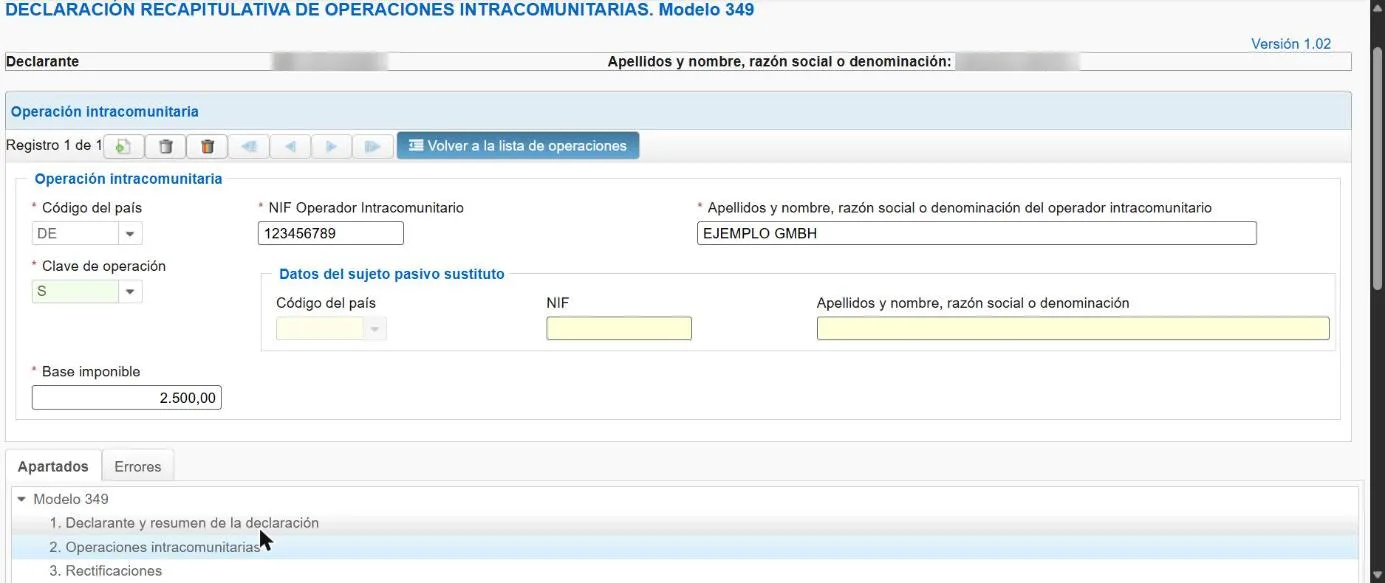
The Sede screens, by their Spanish labels
On the form's page in sede.agenciatributaria.gob.es, the filing link is «Modelo 349. Ejercicio 2026. Presentación (hasta 40.000 registros)». After you identify yourself, a window titled «Modelo 349 - Sesión» asks for the filer's NIF and the period.
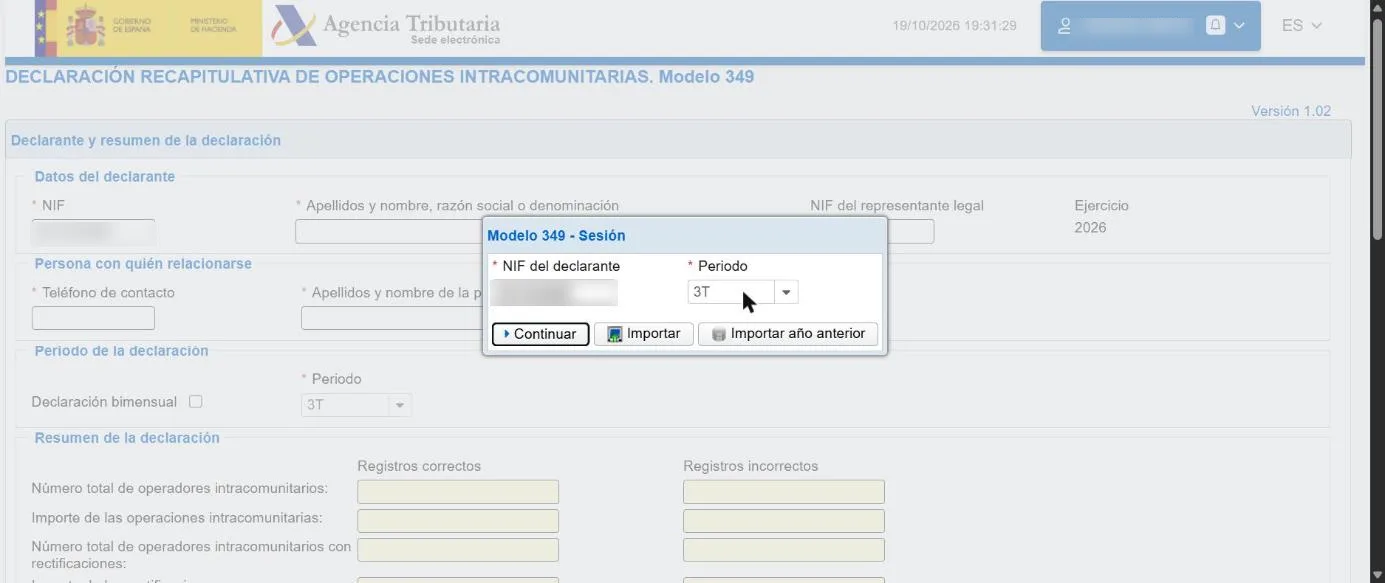
The header then wants your name and a «Persona con quién relacionarse», the contact person, with a phone number. Here the real filing hit its first error. The field holds nine digits and no international prefix: a French mobile typed with 0033 in front was refused with error 10701, «contenido incorrecto en el campo Teléfono de contacto», and a nine-digit Spanish mobile went through.
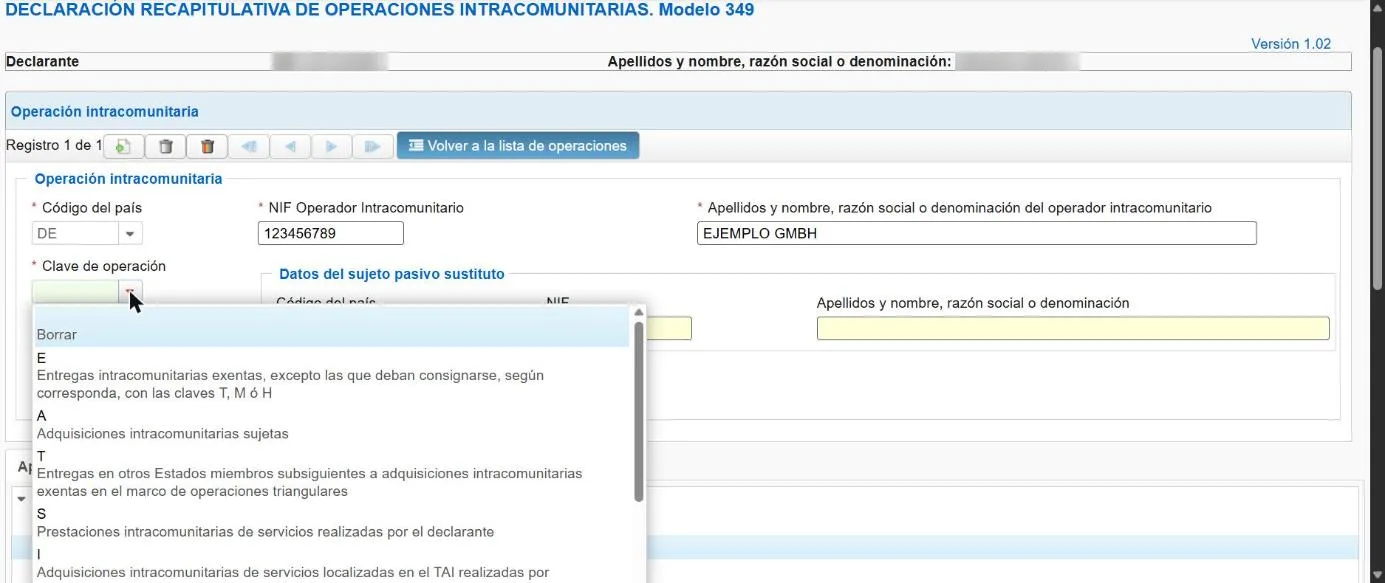
The second trap was the country. Typing «FR» into «Código del país» left «RO» selected, Romania, and it only showed in the check screenshot. Open the list and click the country. Then choose the «Clave de operación»: S is «Prestaciones intracomunitarias de servicios realizadas por el declarante», services you provided.
The summary at the top counts the operators and adds up the amount by itself. With only clave S, no rectifications and the 349 on the same periodicity as the 303, that total must equal box [59]. If it does not, a client is missing on one side or extra on the other.
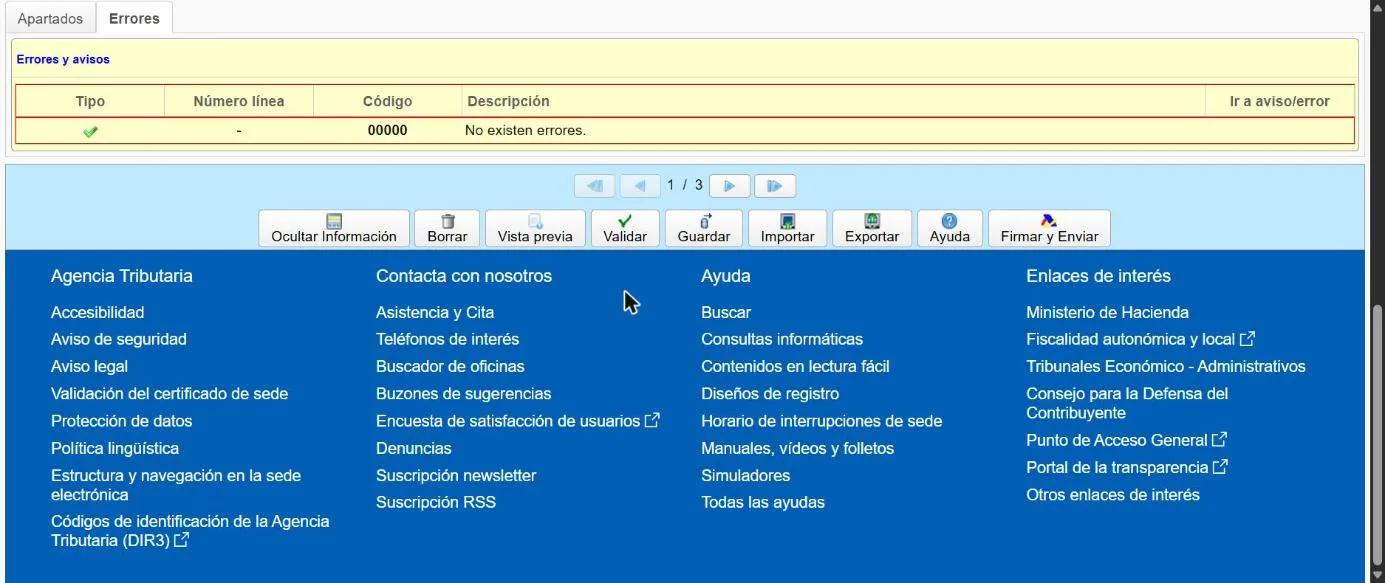
Filing twice replaces, it does not add
«Validar» should answer «No existen errores» before you press «Firmar y Enviar». If the period already has a filed 349, the Sede warns that the new return will delete every record already filed that it does not include. On the web form there is no supplementary 349: a new filing for the period replaces the previous one entirely, so it must carry every client again. To fix a line without retyping the rest, enter through «Cargar la declaración presentada», which brings back all the lines. An error in an earlier period can also be corrected in the «Rectificaciones» section of a later 349 (RIVA art. 80). Answering «No» to the warning sends nothing.
Coming from the UK or the US: the EC Sales List and its missing American twin
If you ran a VAT-registered business in Britain before 2021, the 349 will look familiar. It is the Spanish version of the EC Sales List that HMRC used to collect: the same idea of reporting each EU business customer by VAT number, so that the customer's country can match it against the VAT that customer accounts for. For sales made from 1 January 2021, when the Brexit transition period was over, businesses in Great Britain no longer submit EC Sales Lists. Northern Ireland kept one for goods sold to VAT-registered EU customers, but not for services, so a British freelancer who only sells services has had nothing like it since 2021.
Two things to note. The 349 has no box for service customers outside the EU, so a client in London or New York goes into the 303 but never into the 349. And the Spanish deadline is set by RIVA art. 81: the first 20 days of the following month, and 30 January for the last period, against the 21 days HMRC gave for an online EC Sales List.
For American readers there is nothing to compare it with. The United States has no federal VAT; sales tax is a state matter and is charged to the buyer at the point of sale, and no return asks you to list your business customers by tax number. The closest habit, sending a 1099 to a contractor, runs the other way: the payer reports the person paid. Under the 349 it is you, the seller, who names your EU buyers every quarter, even when the tax due is zero.
Frequently asked questions
- Do I file a 349 for clients in the UK, the US or Switzerland?
- No. For services, the 349 lists only operations with businesses in other EU Member States (RIVA art. 79). A British or American client still goes into your Modelo 303, but not into the 349.
- My client gave me a VAT number starting with FR: what do I type?
- Pick France in «Código del país» and type only what follows the letters in «NIF Operador Intracomunitario». In the real case that was the 11 characters after FR.
- Does my own Spanish NIF need anything before I can bill EU clients this way?
- Yes: it has to be registered in the Registro de Operadores Intracomunitarios (ROI), which you request in the census form Modelo 036. Your EU client can look up your ES number in the EU's VIES database.
- Does AYFI file the 349 for me?
- No. AYFI prepares each client's line from the invoices you issued (country, VAT number, base) and shows the total that must match box [59] of your 303. Signing and sending in the Sede is done by you.
Sources
- AEAT — Modelo 349. Recapitulative statement of intra-Community operations
- RIVA art. 79 — Who must file the recapitulative statement
- RIVA art. 80 — Content of the recapitulative statement
- RIVA art. 81 — Deadline and period of the recapitulative statement
General information, not a substitute for a professional. AYFI files nothing for you.